
Case Study
Nov 2, 2025
Industry: FMCG / Beverages Channels: GT, MT, Key Accounts, E-commerce Systems: ERP, DMS, OMS + marketplaces (Instamart, Blinkit, Zepto, Amazon, etc.)
The Business Challenge
Fragmented sales visibility across SKU, channel, and regional performance; primary, secondary, and tertiary sales tracked in silos
Manual MIS workflows reduced trust in numbers
Slow root-cause analysis - “whys” behind underperformance took 2–3 days
Ad-hoc requests from product / marketing teams took 1–2 days, with outputs shared largely through spreadsheets
The Operational Challenge
A prior sunk-cost with database + PowerBI + orchestration tools ran for ~6 months without any deliverables
Master data fragmentation across GT, MT, E-commerce, and Key Accounts made consistent reporting difficult
Distributing insights to 350+ sales + other teams (RSM / ASM / Sales Officers) manually - An operational bottleneck
MIS teams faced increasing data volumes and spreadsheet-heavy workflows, creating burnout and attrition risk
What We Built
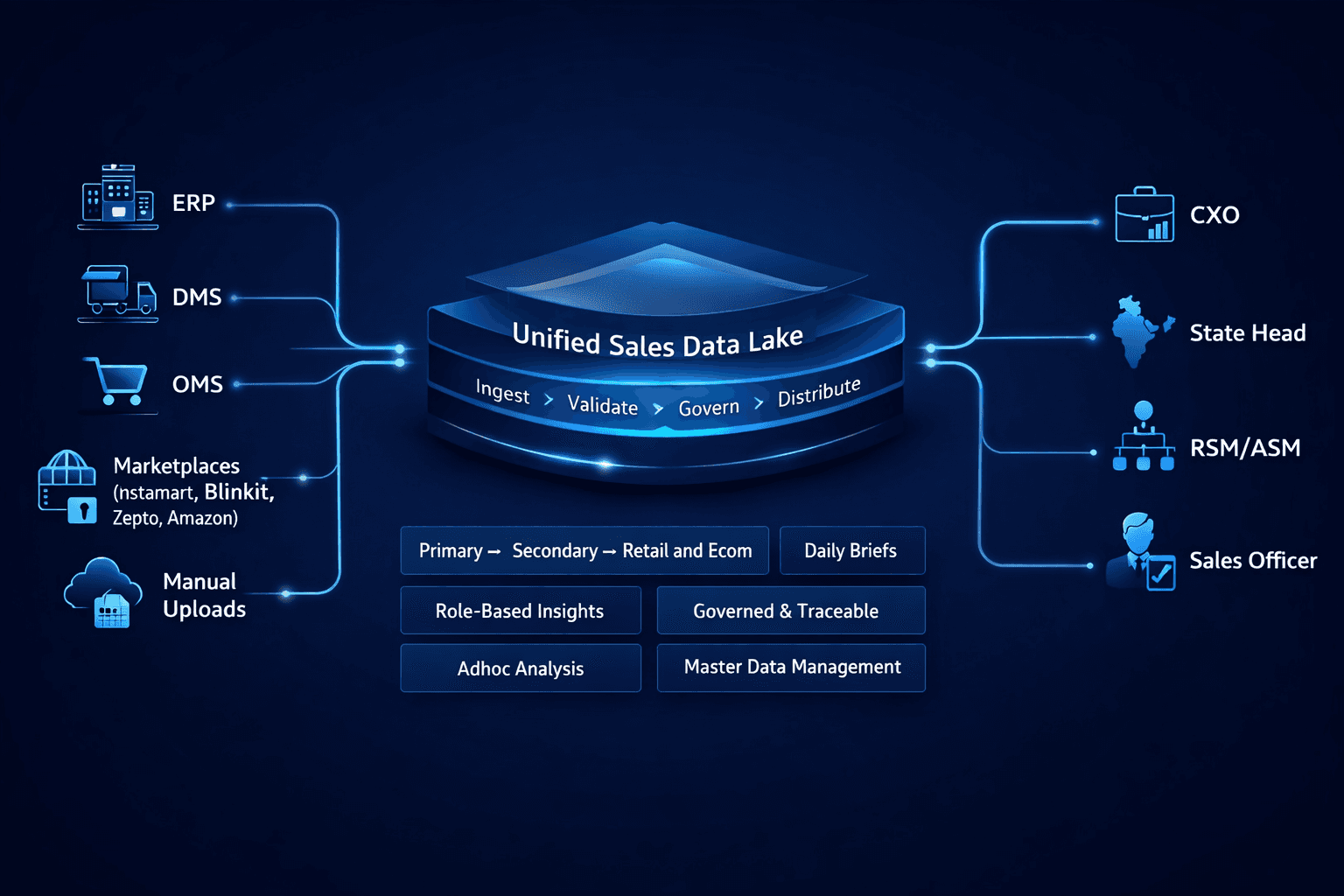
A unified revenue operations foundation that ingests, processes, and distributes decision-ready insights across teams — without changing how the field operates.
Data Ingestion & Coverage
Direct ingestion with ERP, DMS, OMS, Ecom / Qcom protals, with the flexibility of one-click refresh
Masters (product, sales, pricing, etc.), targets (P/S/T), stock positions, pricing, and manual uploads where required
Execution Layer
Distributed processing for large datasets to optimize cost and performance
Data quality & master data management – notifications on anomalies or new codes for MIS team’s actionable
Role-based visibility and automated daily briefs (automated emails) for CXO, State Heads, ASM/RSM, Sales Officers, and field teams
Controlled data sharing for cross-functional stakeholders beyond MIS and Sales
A scalable foundation for AI-based summarization, conversational exploration, and visualization for strategy and CXO discussions
Our Implementation Strategy
CEO’s non-negotiable ask: “My sales teams are on the ground and are performing great. They should not be impacted in any way.”
Given the previous experience and the need for speed, we executed the rollout in 3 months using three principles:
Do not reinvent what already works. Digitize for faster response, scalable infrastructure, and reliable execution.
Minimize the learning curve for MIS teams: Keep familiar nomenclature and spreadsheet-style views while improving automation and control.
Build clean history first — then layer AI: Automate the data foundation and governance before introducing intelligence on top.
Impact
Faster, more reliable visibility across primary → secondary → retail/e-commerce
~80% reduction in noise through role-based distribution (e.g., Gujarat RSM sees only Gujarat insights)
~50% MIS bandwidth unlocked by reducing repetitive reporting effort and improving workflow sustainability
Improved operational continuity in a high-attrition environment, with unlocked bandwidth utilized for better work
Key Takeaway
The biggest unlock wasn’t dashboards – It was building a governed foundation where master data, automation, and role-based distribution governance work together.
That’s what made sales intelligence faster without disrupting the business