
Article
Feb 5, 2026
The success of enterprise AI won’t be defined by how powerful or fine-tuned a model is, but by whether businesses trust the decisions it informs. Trust in AI is built the same way it is between humans — over time, through clarity, traceability, and the ability to answer “how” and “why.” Without verifiable reasoning and transparency, even the smartest AI remains a black box that businesses hesitate to rely on.
What High-Frequency Trading Taught Us About Machine Decisions
When algorithmic trading emerged in the early 2000s, regulators and institutional investors didn’t simply trust machines to execute million-dollar trades in milliseconds. The speed advantage was obvious, but so was the risk. How could you trust a black box making split-second decisions with other people’s money?
Trust wasn’t granted - it was earned through mandatory audit trails. Every algorithmic trade required a complete record: the strategy logic, the market data inputs, the decision triggers, and the execution path. When trades went wrong (and they did), firms needed to reconstruct exactly what happened and why.
Today, we’re introducing Large Language Models into enterprise decision-making. While the context is different (trading algorithms were deterministic; LLMs are probabilistic), the fundamental challenge remains: new technology that makes consequential decisions must earn trust through verifiability.
The GenAI Paradox: Power vs. Opacity
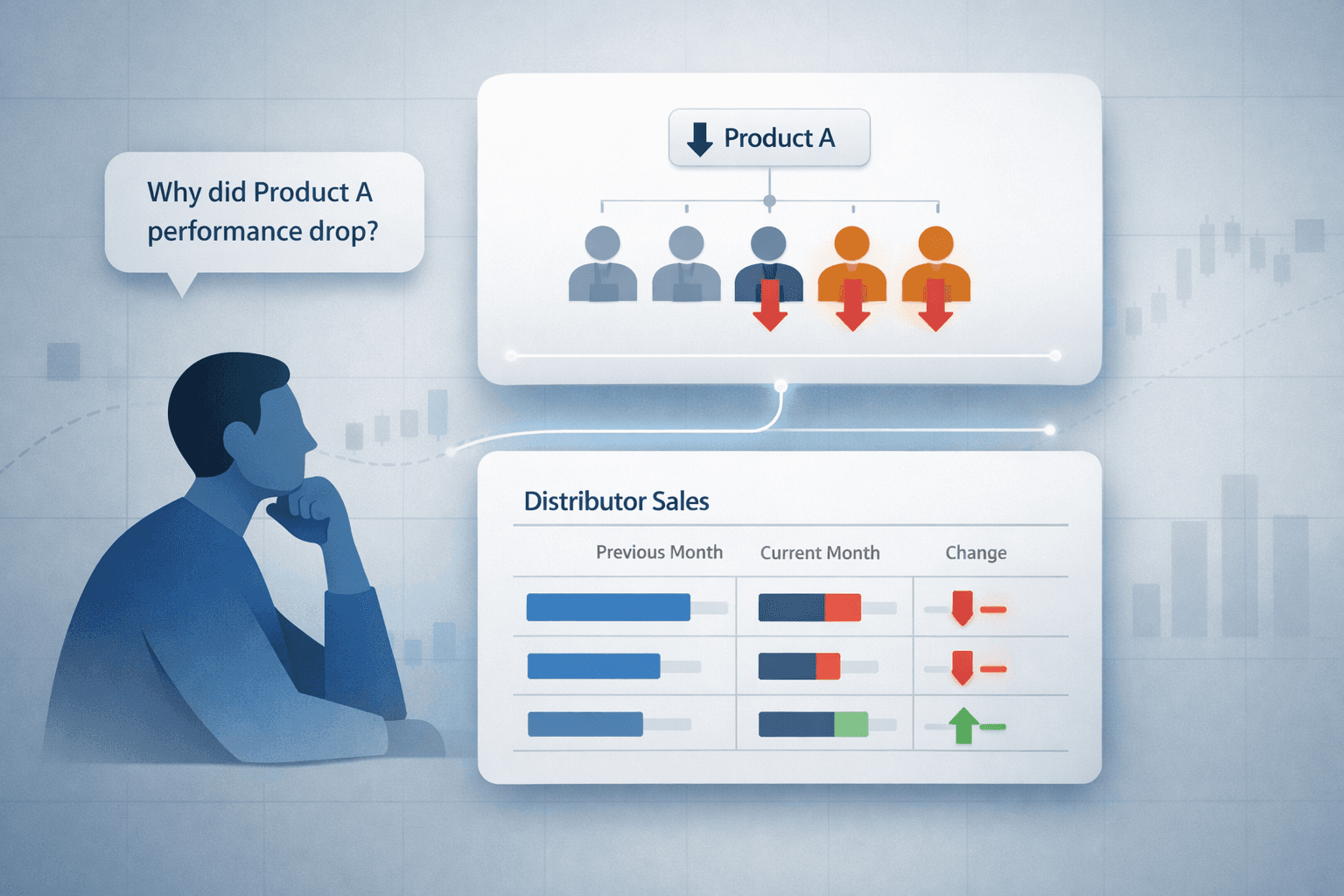
In traditional software, debugging is straightforward - find the failed logic gate or SQL line. In Generative AI, we face Opacity Risk. When an AI analyst reports 12% revenue growth but internal reports show 8%, confidence collapses immediately.
LLM fluency - sounding incredibly confident - is a double-edged sword. In the boardroom, unexplained insights become liabilities. But here’s the critical caveat: explainability alone doesn’t guarantee correctness. An LLM can generate plausible explanations for wrong answers. The goal is creating verifiable explanations connecting to ground truth data that humans can independently validate.
The GenAI Transparency Layer: Paying the “Trust Tax”
Most GenAI architectures focus on the Action Layer (LLM outputs) and Data Layer (source systems). The missing middle is the GenAI Transparency Layer — infrastructure capturing the “Reasoning Trace” through query logs, retrieval records, chain-of-thought outputs, data provenance, and confidence indicators.
Building this requires the Transparency Tax - significant overhead at every stage. The hidden costs are real: 20–40% performance degradation, doubled storage requirements, increased engineering complexity, and ongoing maintenance burden. Many teams evade this tax to ship fast, creating technical debt that blocks adoption.
While the Transparency Tax is an upfront burden for the team, it is the only investment that pays dividends in user trust during the adoption phase.
When Transparency Matters (and When It Doesn’t)
Critical decisions (financial calculations, regulatory compliance, healthcare): Transparency is non-negotiable. The cost of errors exceeds the transparency tax.
Collaborative decisions (business intelligence, strategic planning): Transparency significantly accelerates adoption by enabling human review, though human-in-the-loop workflows can provide adequate safety.
Low-stakes automation (content suggestions, UI recommendations): Transparency may be overkill. Users can accept or reject based on face validity.
The Sales Reality: Why Traceability Accelerates Adoption
While transparency costs development time, it creates measurable adoption advantages. In our experience building AI data tools:
Faster validation: When customers can verify AI-generated SQL queries directly, proof-of-concept cycles shrink from weeks to days.
Reduced friction: IT security teams can audit data access and processing logic independently, removing approval bottlenecks.
Empowered champions: Business analysts can confidently present AI results when they have the “receipts” - queries, data sources, reasoning chains.
The Determinism Problem
Traditional audit trails assumed determinism - run the same banking transaction twice, get the same result. Execute the same trading algorithm with identical market data, get the same decision. LLMs fundamentally don’t work this way. Temperature settings, model updates, or inherent randomness mean identical prompts can yield different outputs.
This creates a profound challenge for enterprise adoption: how do you audit a process that isn’t reproducible?
Consider the implications. In traditional systems, if a decision is questioned weeks later, you can replay the exact inputs and verify the output. With LLMs, replay might produce a different answer - perhaps a better one, perhaps worse, but different. This breaks the fundamental assumption underlying most corporate audit frameworks.
The challenge deepens when you consider that even logging everything doesn’t solve the problem. You can record the model version, the prompt, the temperature setting, the retrieved data chunks, and the reasoning chain. But that record proves only what happened, not what would happen again. You’re left verifying that the process was sound rather than confirming the outcome was correct.
This means “auditing” an AI decision often reduces to confirming the approach was reasonable and the data sources appropriate - not that the answer was provably right. For many enterprise use cases, this level of process auditability proves sufficient. For truly critical applications requiring outcome reproducibility, it raises harder questions about whether current LLM architectures are fit for purpose, or whether they should remain in advisory roles with deterministic systems making final decisions.
Conclusion: Trust as a Competitive Advantage
Generative AI can process information and generate insights at scale, but enterprise decisions require justification. The gap between “the AI says” and “we can verify” often determines whether a proof of concept reaches production.
Teams investing in transparency infrastructure today - while clear-eyed about costs and limitations — will likely gain an adoption advantage. They’re offering accountability, not just capability.
But transparency is a means, not an end. The goal is AI systems that are trustworthy, combining powerful capabilities with appropriate safeguards - whether through transparency, human oversight, rigorous testing, or some combination.
Here’s the uncomfortable truth: when algorithmic trading emerged, firms that resisted audit trails eventually faced a choice — build the infrastructure or exit the market. Regulators made transparency mandatory. With GenAI, we’re in the window before the mandates arrive. The question isn’t whether AI systems will need to justify their decisions, but whether you’ll build that capability proactively or reactively.
The firms winning enterprise adoption today aren’t the ones with the most powerful models. They’re the ones whose AI can answer the follow-up question: “How do you know?”