
Article
Jan 5, 2026
AI doesn’t fail because it lacks intelligence - it fails because it lacks context. Without your company’s tribal knowledge, AI can only guess based on generic patterns. This article explains why leaders must document key metric definitions, internal events, and cause-effect relationships to help AI deliver real business answers. When knowledge is codified, it becomes a reusable digital asset that improves accuracy, saves time, and preserves institutional memory.
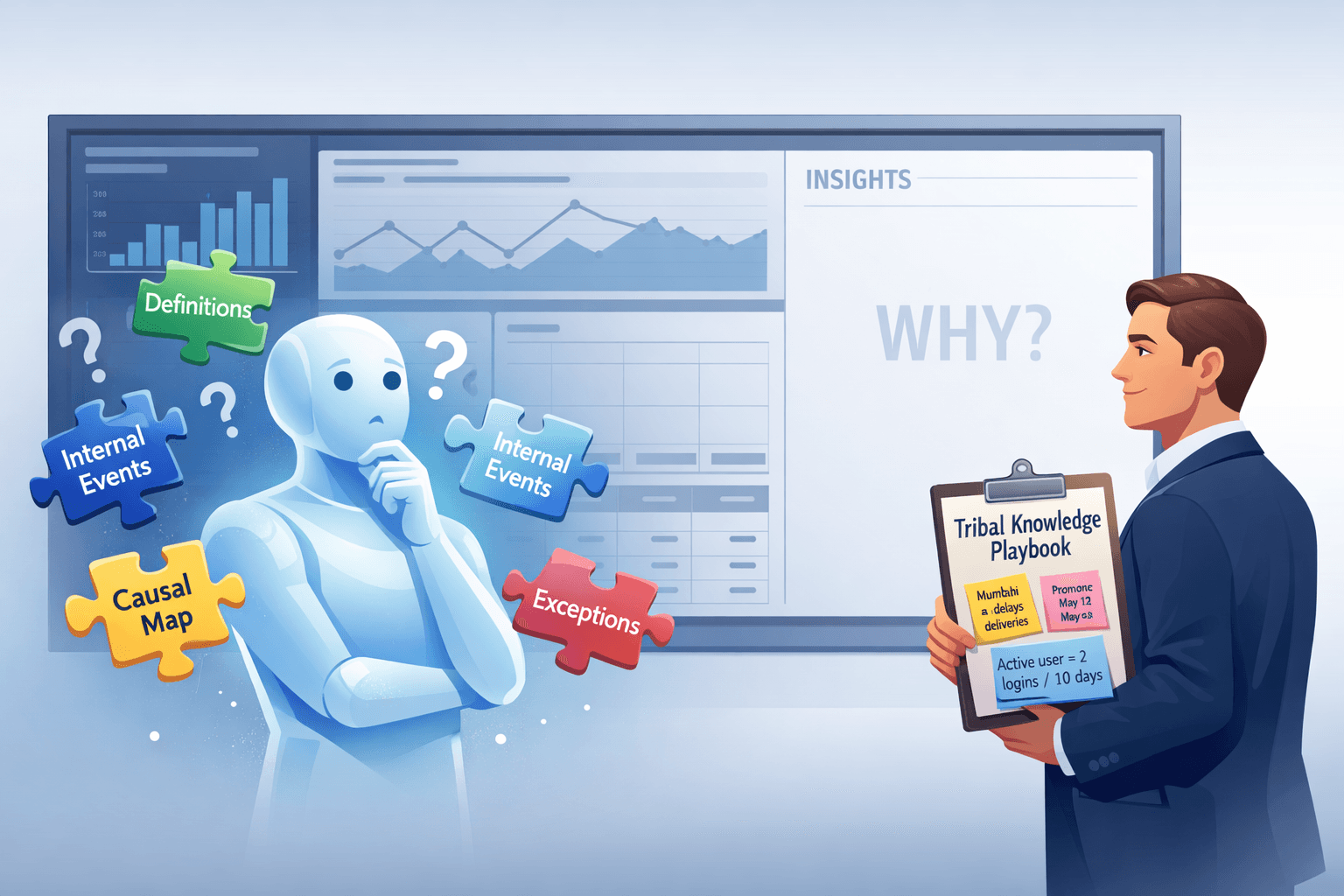
We’ve all been there: You ask a sophisticated AI data analyst a simple question like, “Why did our revenue dip in Mumbai last month?” and the response you get is a generic summary of numbers you already knew. Or worse, a guess that feels completely detached from your actual business reality.
The problem isn’t the AI’s “IQ.” The problem is a Context Gap. To an AI, your company looks like a series of rows and columns. It doesn’t know your history, your strategy, or your “secret sauce.”
To get real answers, you have to share your Tribal Knowledge.
What is Tribal Knowledge?
In most companies, the most valuable information isn’t in a database — it’s in the hallway.
It’s the manager who knows that “Active Users” actually means people who logged in twice in ten days.
It’s the salesperson who remembers that a 15% dip in May was due to a supply chain issue, not a lack of marketing.
It’s the “unspoken rules” that everyone knows but no one has written down.
The Three Types of Knowledge Your AI Needs
If you want your AI to act like a senior partner rather than a junior intern, you must feed it three types of knowledge:
Logic & Definitions: How you specifically define success (e.g., “Churn,” “Lead Quality”, “Revenue Realization”). This prevents the AI from using generic industry standards that don’t fit your unique model.
Internal Events: A timeline of things you did (e.g., price changes, marketing launches, system outages). This provides the “Why.” Without this, the AI sees a spike in data but has no “cause” to attach it to.
Causal Maps: Your understanding of how one thing affects another (e.g., “Heavy rain stops our deliveries”). This gives the AI a “Mental Model” of your specific industry’s physics.
The Impact of “Context Silence”
What happens when you don’t document this tribal knowledge in your AI system?
Speculation: The AI starts to hallucinate reasons for trends based on generic data.
Wasted Time: You spend hours “correcting” the AI instead of using its insights.
Institutional Memory Loss: When a key manager leaves, the AI “forgets” the business logic that person held in their head.
Why Sharing Knowledge is a Value Multiplier (Not a Chore)
The biggest hurdle for many leaders is the feeling that documenting this logic is just “more data entry.” In reality, this is the highest-leverage activity a business leader can perform.
Think of it as Documentation as Code. You aren’t just writing a note; you are building a Digital Asset.
Compound Interest for Your AI: Every time you define a rule or log an event, the AI’s baseline intelligence for your company rises permanently. It never has to be told twice.
Scaling Your Expertise: By codifying your “Tribal Knowledge,” you are effectively cloning your best analysts. The AI can now apply your logic to millions of rows of data in seconds — something a human can never do.
Asset Protection: When tribal knowledge is trapped in human heads, it is a liability. When it is codified in your system, it becomes a permanent intellectual property that adds tangible value to your organization.
Eliminating the “Psychic AI” Expectation: Businesses often blame AI for being “dumb” when they actually just kept the “answer key” in their heads. Sharing knowledge is the only way to hold the AI accountable.
The Tribal Knowledge Checklist
What to document before you ask “Why?”
1. The Metric Dictionary
Standardize definitions that don’t exist in your database schema.
Active vs. Inactive: At what exact point of silence do you consider a customer “churned”? (e.g., 30 days vs. 90 days).
Qualified Leads: What specific behavior (e.g., clicked a demo vs. signed up for a newsletter) makes a lead “High Value” in your eyes?
2. The Internal Event Log
Identify the “invisible” shifts that explain spikes or dips in your charts.
Pricing & Promotions: When did you last change your shipping rates, subscription tiers, or launch a flash sale?
Operational Shifts: When did you switch logistics providers, change a warehouse location, or experience a significant system outage?
Market Interventions: When did you increase ad spend on a specific channel, or when did a key competitor launch a predatory pricing campaign?
3. The Causal Map
Define the “Rules of Thumb” that govern your specific industry.
Lead Times: How long is the typical lag between a marketing click and a confirmed sale? (e.g., “7 days for Retail, 45 days for Enterprise”).
Cannibalization: Does a sale in Category A typically steal revenue from Category B?
External Influencers: Even if it’s not in the data yet, do you know that heavy rain in Mumbai stops your deliveries? Document that relationship so the AI knows where to look.
4. Exceptions & Guardrails
Tell the AI which data points to ignore to prevent “hallucinated” insights.
Test Data: Which accounts or regions are used for internal testing and should always be excluded from performance reports?
Outlier Rules: At what transaction size does a sale become an “outlier” (e.g., a B2B bulk order) that shouldn’t skew your Average Order Value?
The Responsibility Shift
The next time your AI gives you an answer that feels “off,” ask yourself: “Did I give it the playbook?” The future of business belongs to the leaders who don’t just use AI, but brief their AI. Sharing your tribal knowledge is the only way to turn a generic tool into a competitive advantage. You are not “helping the machine” — you are scaling your own intelligence.