BSP Submission Platform
For banks that prepare their reports outside the platform and want the last mile governed.
Two parts, one governed chain. Source-to-Report Automation builds the figures and records from your core systems. The BSP Submission Platform validates, approves and files them. Start with the last mile, or take both.
Core-system extracts, personal worktables and formulas re-run in Excel every cycle, with the logic living in analysts’ heads.
COCREE 2.0 expects the BSP’s own code lists for products, locations, countries and currencies, not the codes your systems use.
Without the BSP’s rules running in-house, exceptions surface as rejected submissions and resubmissions against the deadline.
The BSP defines computed cells, cross-schedule references and assertions in a language that is neither Excel formulas nor SQL.
Both options file through the same BSP Submission Platform. The difference is where the figures and records come from.
For banks that prepare their reports outside the platform and want the last mile governed.
For banks that also want the figures and records built from source systems, with governance from the first load.
| Capability | Option A · Submission Platform | Option B · End to end |
|---|---|---|
| Preparation · Part 1 · Source-to-Report Automation | ||
| Upload final Excel reports and record files prepared outside the platform | Included | Included |
| Report versioning, with controlled report-level adjustments | Included | Included |
| Business validations framework and regulatory code management | Included | Included |
| Preparer maker-checker and a complete audit trail | Included | Included |
| Automated data sourcing from core banking, treasury, ledgers and warehouses, on schedule | Not included | Included |
| A versioned, quality-checked data foundation that every figure traces back to | Not included | Included |
| Your Excel logic, masters and code mappings turned into governed rules | Not included | Included |
| Reports generated automatically, in templates your team already reads | Not included | Included |
| Data-level adjustments, with drill-downs and lineage to source | Not included | Included |
| Change management studio, with every rule and artifact versioned | Not included | Included |
| Submission · Part 2 · BSP Submission Platform | ||
| Regulator-mandated validations on aggregate and granular numbers | Included | Included |
| A separate maker-checker for the submission team | Included | Included |
| XSD-conformant XML or TXT, submitted via API, with tracking and filing history | Included | Included |
| Regulator to-and-fro: rejections, corrections and resubmissions | Included | Included |
A governed filing is only as good as the figures behind it. Part 1 automates the journey from your core systems to finished FRP schedules and COCREE 2.0 records, in user-readable templates, with its own maker-checker and audit trail for the preparation team. Approved outputs are handed straight to the Submission Platform. It runs on the same platform as our regulatory reporting solution.
The last mile of BSP reporting. Your team uploads the final Excel, prepared outside the platform or handed over from Part 1, and runs the validations the regulator mandates on the numbers, aggregate or granular. A separate maker-checker serves the submission team, and every exchange with the regulator, from rejection to resubmission, is tracked here. Each regulation is a package on the same engine.
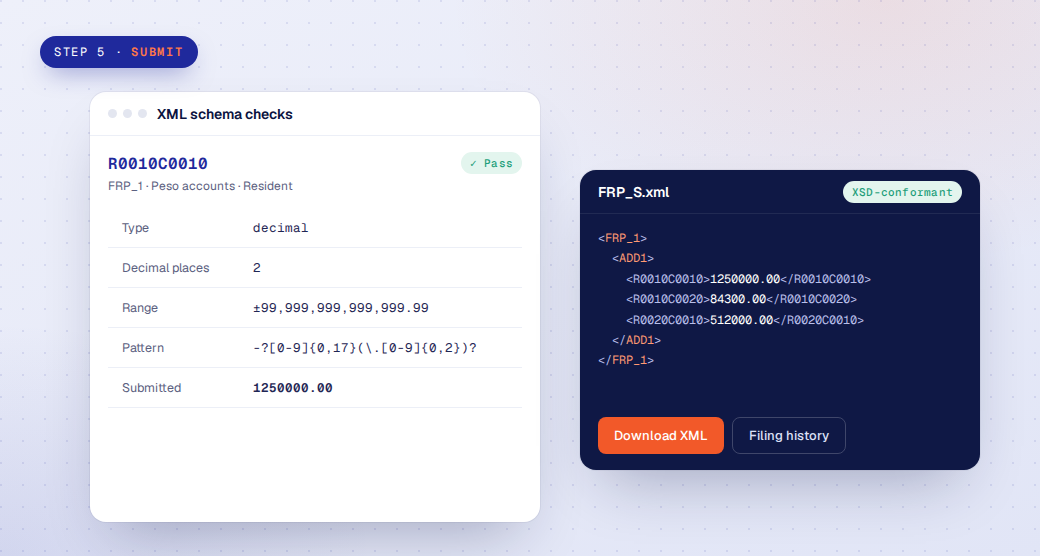
The Financial Reporting Package is filed as schedules of figures. The platform takes the template your team fills in, or the schedules Part 1 computes, maps it to the BSP’s structure, and runs the regulator’s own checks before the file leaves the bank.

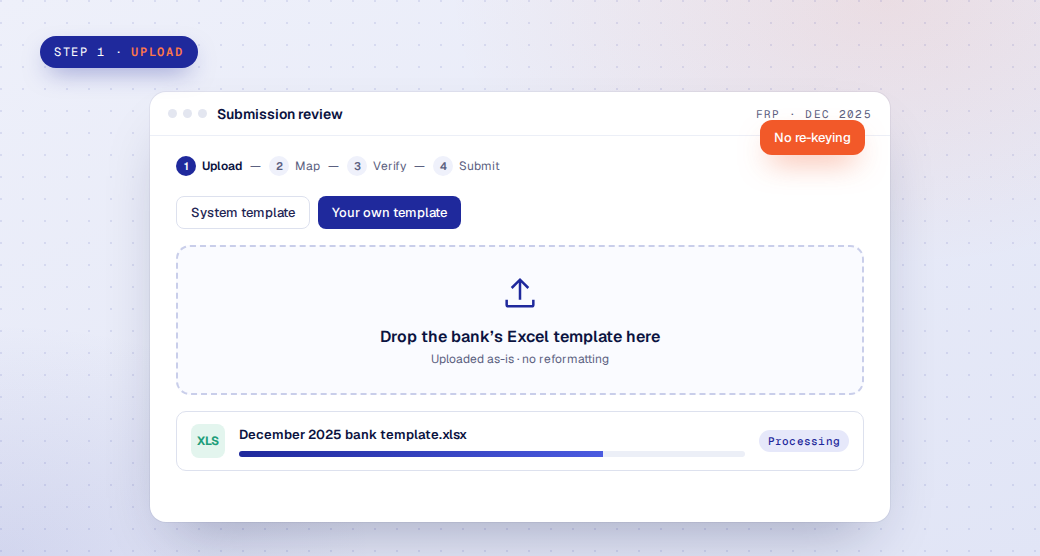
Upload the system template or your own workbook, with no re-keying or reformatting.

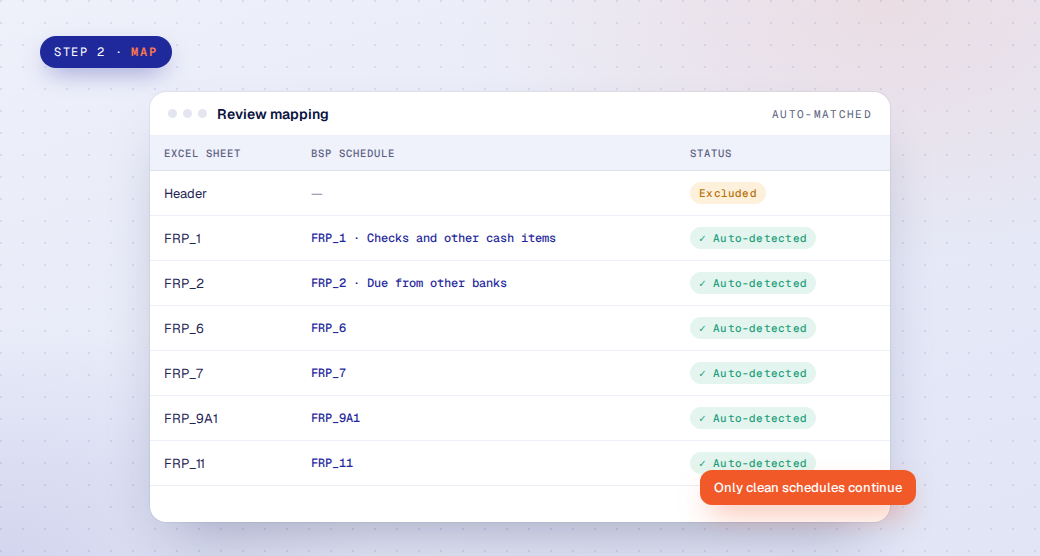
Sheets are auto-matched to BSP schedules. Anything that doesn’t map is flagged and left out.

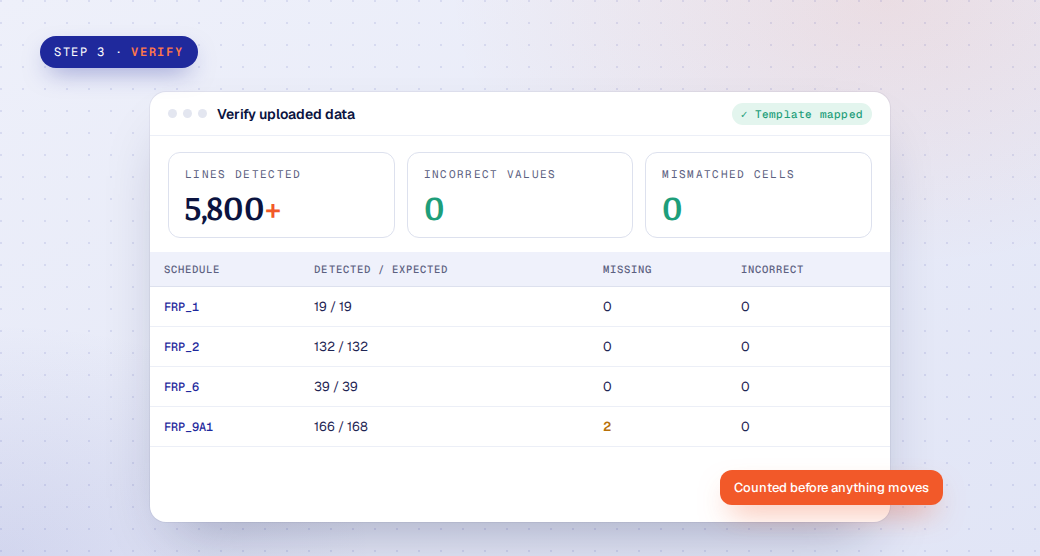
Detected, expected, missing and incorrect lines per schedule, with the mapped template to download.

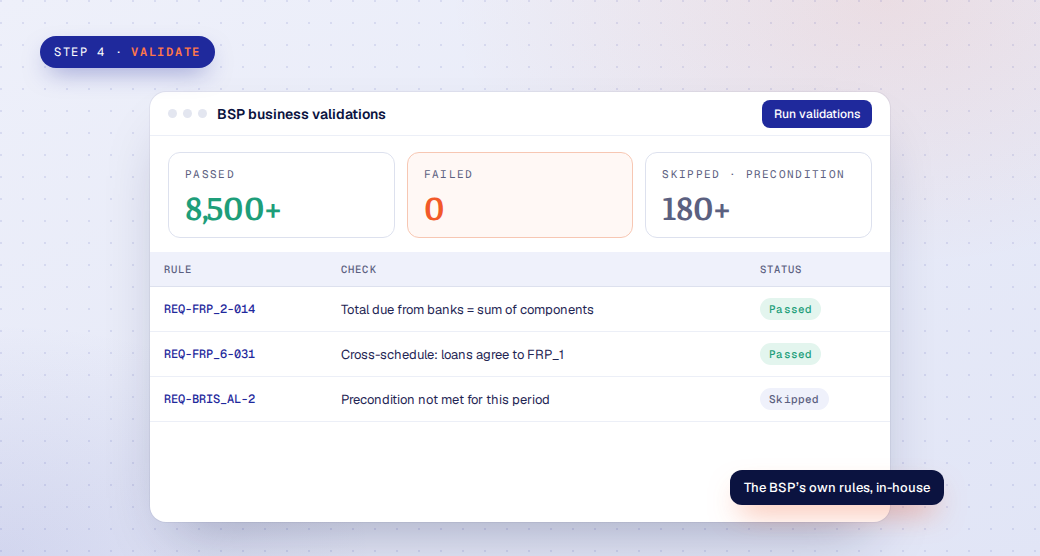
Every rule runs with its preconditions, so rules that don’t apply to the period are skipped, not failed.

Each element is checked against the published XSD, approved by the submission team and filed, with regulator feedback tracked until accepted.
COCREE 2.0, the BSP’s Enhanced Comprehensive Credit and Equity Exposures Report, asks for borrower- and counterparty-level records on every credit and equity exposure. The regulator checks every file but provides no validation tool, so the bank has to build its own pre-flight checks. This package is that pre-flight, and the filing workflow around it.
A header and footer declare the provider, the period and the expected counts of subjects, contracts and negative events.
Every borrower, co-borrower, guarantor or surety, and the links between them, such as directors, owners and parents.
Six contract types, from instalment loans and credit cards to investments and off-balance-sheet items, each with role, phase and status.
Litigation, bankruptcy and similar events, recorded against each subject.
| Aspect | What COCREE 2.0 requires |
|---|---|
| Cadence | Monthly for universal and commercial banks, quarterly for rural and cooperative banks, due 25 business days after period end |
| Scale | 12 record types and 700+ fields, with coded domains for locations, countries and currencies |
| Format | A fixed TXT or XML (XSD) structure with every column present, zipped, encrypted and named to the regulator’s rule |
| Validation | Two stages at the regulator: structural errors reject the whole file, and record-level business errors are accepted in part |
| Corrections | Logged as erroneous reporting, which makes checking before submission the bank’s job |

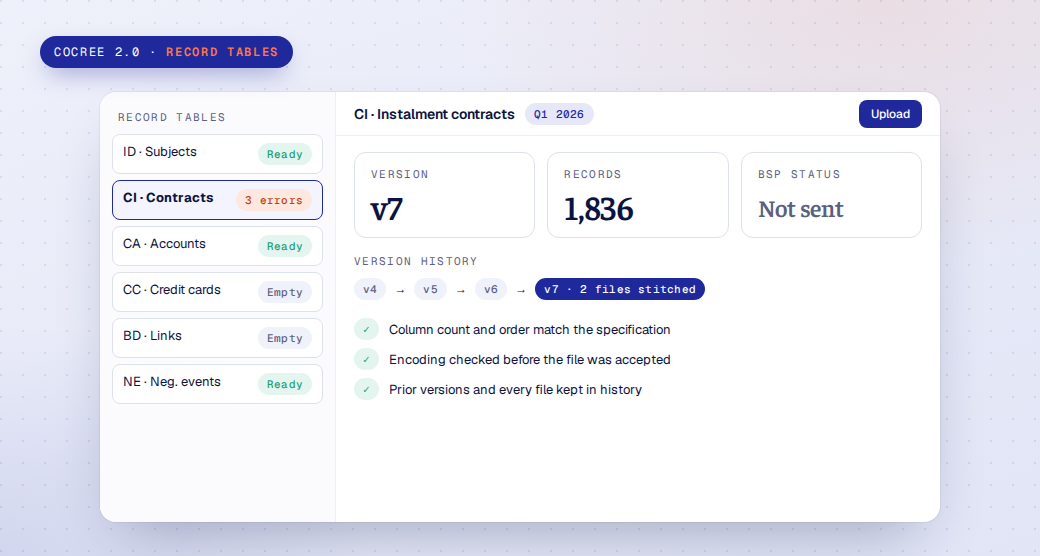
Every record type is a table with its own owner, in specification order. Files append or start a new version, and column count, order and encoding are checked on the way in.

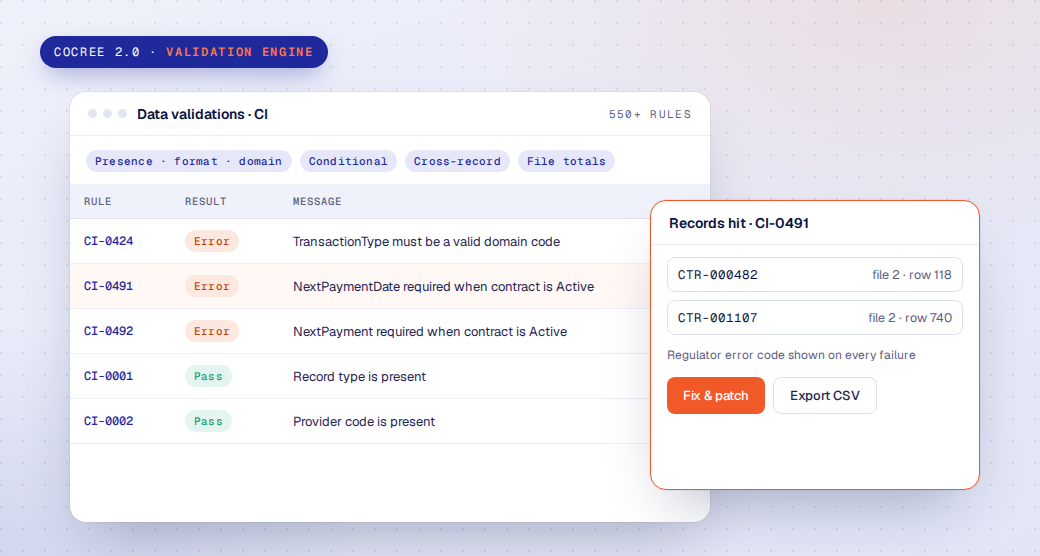
Rules for presence, format and domain; conditional and cross-field; across records and prior filings; and file totals. Failures carry the regulator’s own error codes and open the records behind them.

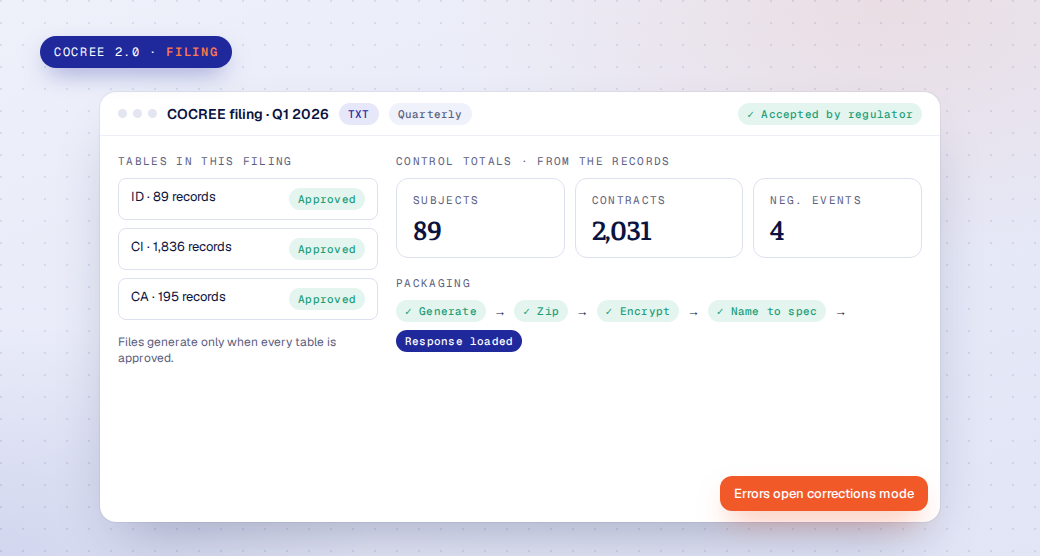
Files generate only when every table is approved, with control totals computed from the records. Response files load back to accept the filing or open corrections.
About COCREE 2.0: the BSP introduced the enhanced report under Circular No. 1184, with live reporting phased in from December 2024 for larger banks and later for rural and cooperative banks. Check current BSP issuances for scope and timelines. Sources: Manila Bulletin, Philstar. Is your data foundation ready for granular reporting? Take the granular readiness check.
Validation-first on every one, with the same maker-checker approvals, evidence capture and filing history.
A separate approval flow for the submission team, who are often not the preparers, with evidence, comments and reminders.
An append-only activity log per submission, time-stamped decisions and a complete trail across every version.
On-premises, in your own cloud account so data never leaves the bank, or hosted. See our security assurance.
Rejections, corrections and resubmissions tracked filing by filing, until the regulator accepts the submission.
The BSP defines auto-generated cells, cross-schedule references and validation assertions in a specification language of its own. Wekalp executes that language natively, and absorbs each new specification straight from the source documents, release after release.
Yes. The BSP Submission Platform is available on its own. Your team uploads the final Excel, aggregate or granular, prepared outside the platform, and runs the validations the regulator mandates. The submission team gets its own maker-checker, and rejections, corrections and resubmissions with the regulator are handled on the platform. Source-to-Report Automation can be added later without changing the filing workflow.
Seven regulations, each available as a package on the BSP Submission Platform: the FRP, COCREE 2.0, AFRD, WRR, DDA reconciliation, SBLAF and BCCR. Every package runs through the same validations, approvals and filing history.
The FRP is a return-level package: schedules of reported figures that the bank prepares and submits. COCREE 2.0 is granular: it asks for borrower- and counterparty-level records on every credit and equity exposure, in a fixed TXT or XML structure. Wekalp handles both, with template mapping and schedule checks for the FRP, and versioned record tables, record-level validations and packaged files for COCREE 2.0.
Yes. The BSP's business validation rules and the XML schema checks run in-house before you file. Each exception shows the failing rule and where it applies, so it is fixed before submission instead of coming back as a rejected filing.
Yes. Wekalp can be deployed as a dedicated on-premises instance, installed in your own cloud account so data never leaves the bank, or run in Wekalp's hosted cloud.