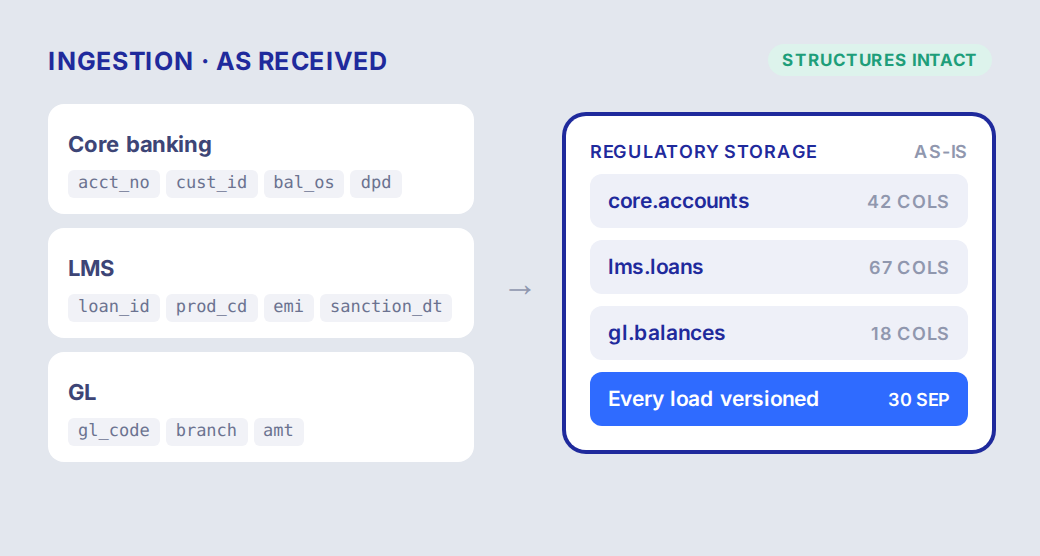
As-is ingestion
Source structures land intact and every load is versioned, so nothing is lost before regulatory logic is applied.

Granular regulatory reporting, also known as granular data reporting, means sending your regulator loan-, account- and transaction-level records instead of pre-aggregated returns. Ten questions on your current reporting set-up produce a weighted readiness score and highlight the areas that need attention. Your responses are not stored or sent anywhere; the score is calculated in your browser.
Source structures land intact and every load is versioned, so nothing is lost before regulatory logic is applied.
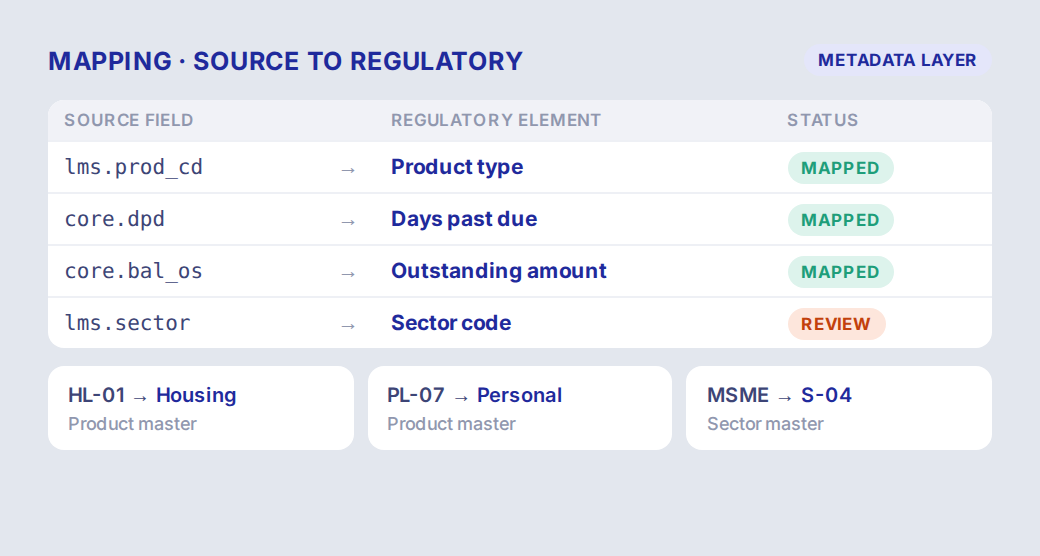
Map source fields and codes to regulatory elements in a metadata layer your team owns and updates.
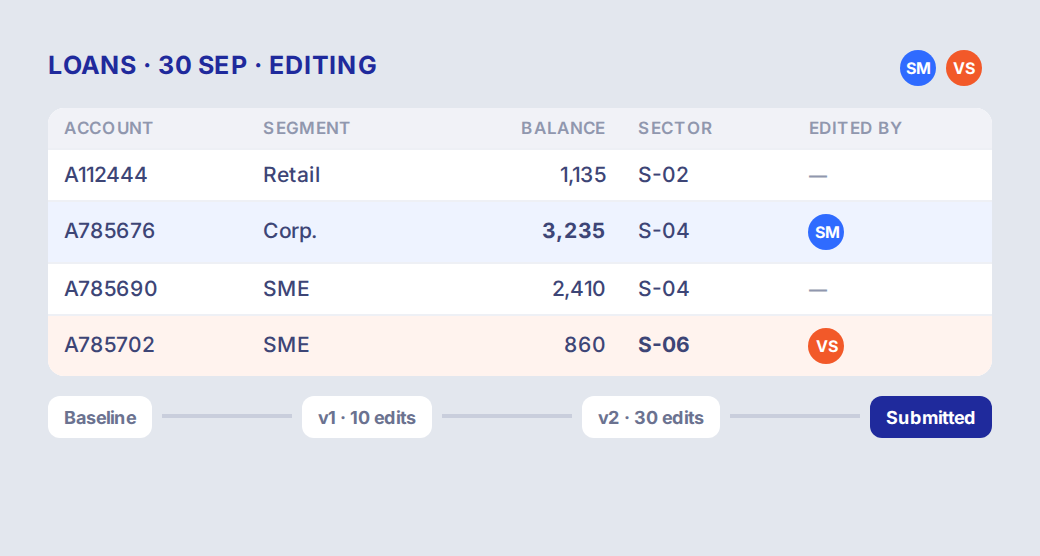
Several users edit records at once, with the baseline and every change kept up to the submitted version.
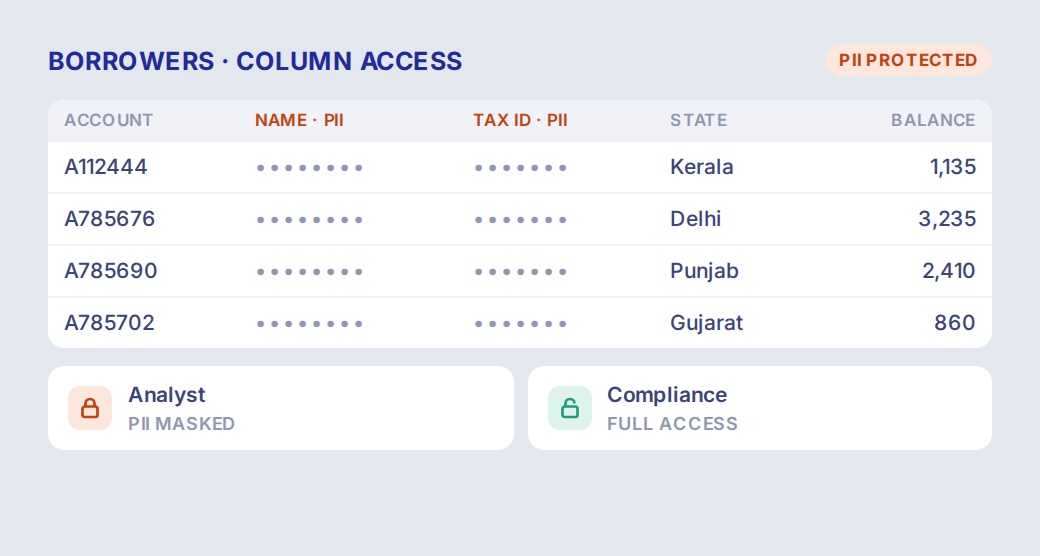
PII columns stay masked for anyone without the right access, controlled down to the column.
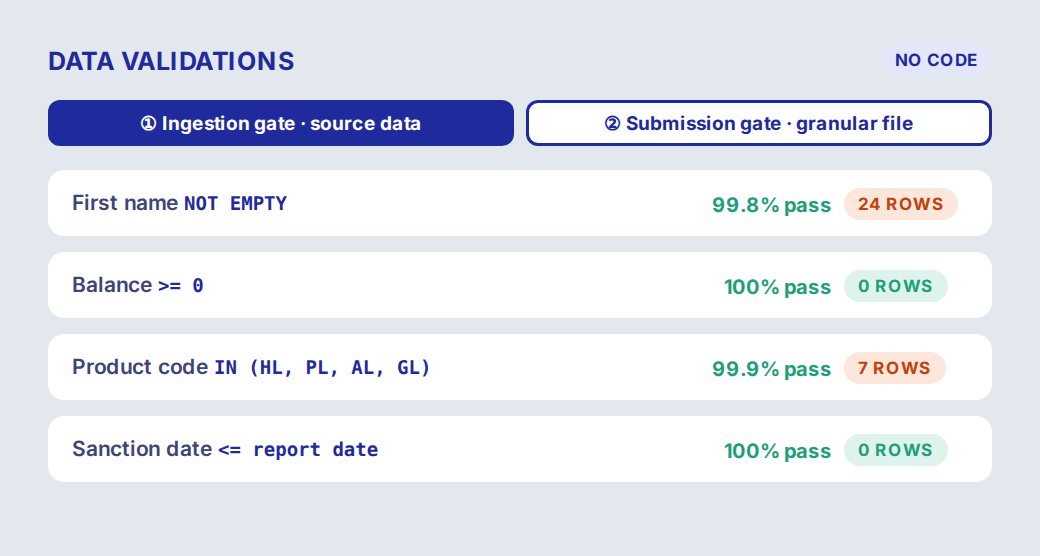
No-code data rules check source data on arrival and granular files again before submission.
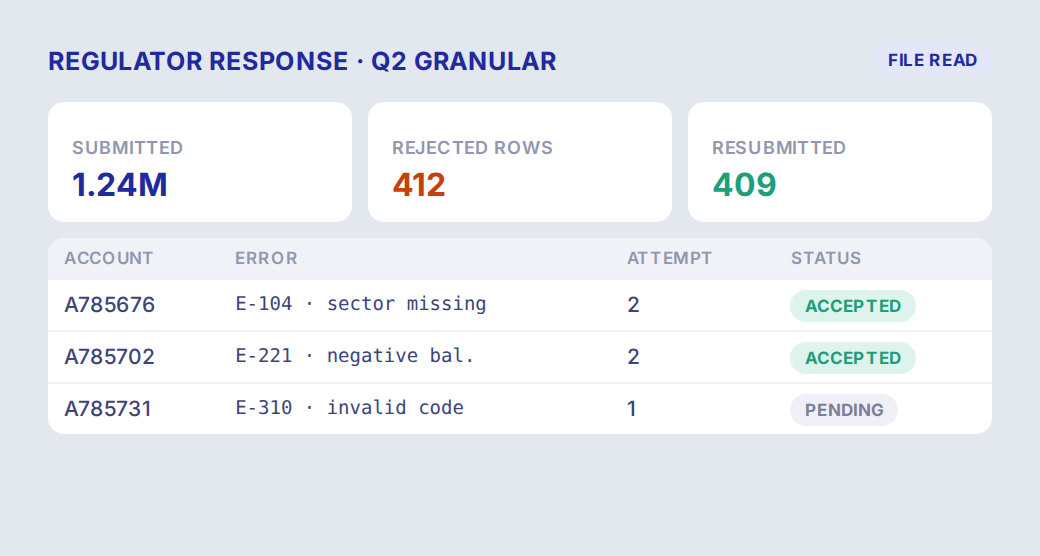
Read regulator rejection files and track submitted, rejected and resubmitted records one by one.
For reference: supervisors already collecting granular data include the ECB (AnaCredit), Austria's OeNB, the HKMA (Granular Data Reporting), the US Federal Reserve (FR Y-14), the Reserve Bank of India (ADEPT, CRILC) and the Bangko Sentral ng Pilipinas (COCREE). Programmes are under way at the ECB (IReF), APRA, the Bank of England and FCA, OSFI, and Bank Indonesia and OJK. This is for information only and is not a list of Wekalp deployments; scope and timelines are set by each regulator.
Granular regulatory reporting is a supervisory model in which banks and financial institutions submit data at the level of the individual loan, account, counterparty or transaction, instead of filling in templates of pre-calculated totals. The regulator receives the underlying records and derives the aggregates, ratios and views it needs. The industry often calls this granular data reporting (GDR).
For a reporting team, the change is less about a new file format and more about the foundation underneath. A template return carries a fixed set of cells; a granular submission carries a row for every account, and each row can be validated, rejected and queried on its own. Spreadsheet workings, manual adjustments and summary-level reconciliations that cope with aggregate returns do not hold up at that volume and level of scrutiny. That is why regulatory reporting software built for granular data starts from record-level, versioned data rather than finished numbers.
In the Philippines, the Bangko Sentral ng Pilipinas already collects granular credit data through COCREE 2.0. In the UAE, the CBUAE’s SupTech initiative is moving supervision onto a single, data-driven platform. Wherever your regulator is on that path, the readiness check above tests the capabilities granular submissions depend on, and our comparison with traditional reporting tools shows where legacy set-ups fall short.
| Dimension | Template-based reporting | Granular regulatory reporting |
|---|---|---|
| What you submit | Pre-calculated totals in fixed templates | Individual loans, accounts, counterparties and transactions |
| Who aggregates | The bank, before filing | The regulator, from your records |
| Validation | Cross-checks between cells and returns | Rules applied to every record |
| Rejections | A return or a cell is queried | Individual rows are rejected and resubmitted |
| Regulatory change | New or revised templates | New attributes or rules on the same records |
| What gets tested | The final numbers | The sourcing, lineage and audit trail behind every row |
Granular regulatory reporting is a supervisory model in which banks submit loan-, account- or transaction-level records to their regulator instead of pre-aggregated template returns. The regulator then derives the totals and ratios it needs. It is often called granular data reporting (GDR).
Template-based reporting sends pre-calculated totals, so the bank does the aggregation. Granular reporting sends the underlying records, so every row can be validated, rejected and queried on its own. Volumes rise, and scrutiny moves from the final number to the data behind it.
Supervisors already collecting granular data include the ECB (AnaCredit), the HKMA, the US Federal Reserve (FR Y-14) and the Bangko Sentral ng Pilipinas (COCREE). Programmes are under way at the ECB (IReF), APRA and the Bank of England, among others. Scope and timelines are set by each regulator.
Wekalp ingests source data as-is with every load versioned, maps it to regulatory elements in a metadata layer your team owns, and runs no-code validations on arrival and again before submission. Record-level edits keep a full audit trail, and regulator rejections and resubmissions are tracked record by record.