From returns to records
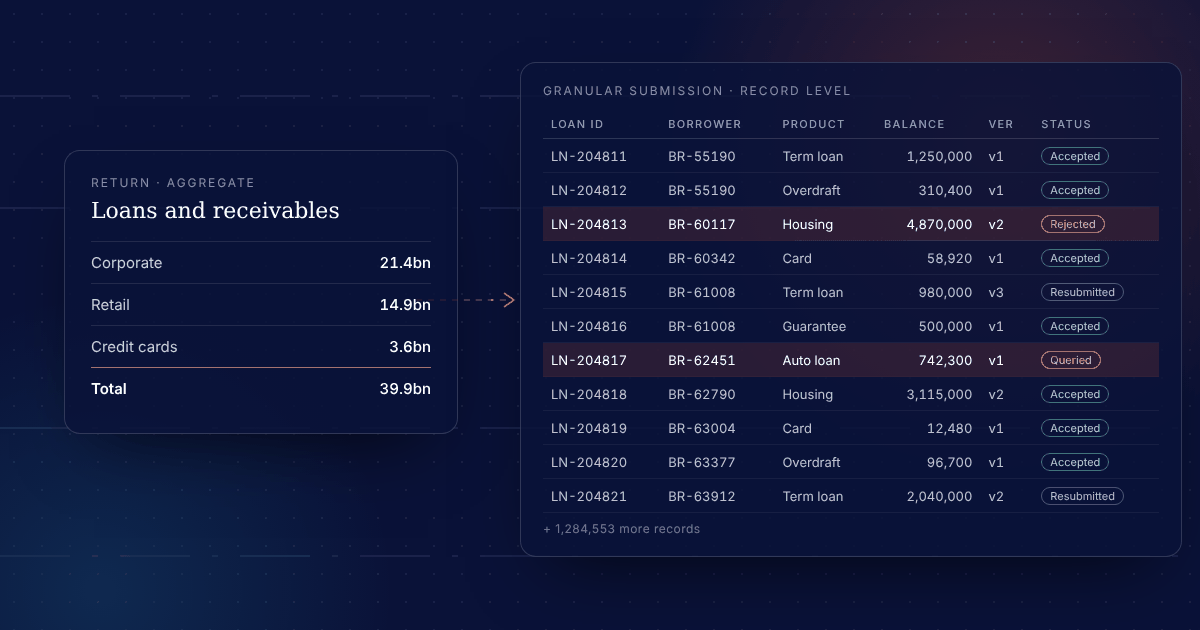
For decades, banks reported totals. The regulator saw the number, and the bank kept the detail behind it.
That arrangement is changing. Supervisors increasingly want the underlying data, as at the reporting date:
- each loan and each borrower
- each guarantor and each piece of collateral
- each exposure, with its status and history
With that, they build the aggregates themselves.
Regulators say as much in their own plans. The HKMA’s April 2026 letter on granular data reporting sets out a principle of “Report Once, Use Multiple”. A December 2020 BIS study of ten supervisors found that most were standardising their data or asking for more granular data.
Much of the industry conversation centres on data dictionaries and file formats. They are necessary, but anyone who has run a granular submission knows the harder work lies elsewhere. We frame it as the Record-Level Contract:
- Four things the regulator expects of every record: Code, Check, Trace and Tie.
- Three loads the bank carries that no specification mentions: Identity, Concurrency and Confidentiality.
It is the second list that most programmes underestimate.
Where granular regulatory reporting is live, or coming
Granular collection is no longer confined to Europe. Supervisors sit at three broad stages:
- Live: the Philippines (COCREE 2.0), Hong Kong (HKMA), the euro area (AnaCredit), Austria (OeNB), the United States (FR Y-14), India (CRILC and the CIMS warehouse) and Thailand (RDT). Canada and the UK already gather loan-level mortgage data, and Australia’s RBA takes loan-level securitisation data.
- Building: Canada’s new collection platform rolls out from August 2026. The ECB’s integrated framework is planned for 2031, subject to adoption of its regulation. Malaysia is modernising collection through Project STREAM.
- Early or undecided: the IMF has advised Uzbekistan’s central bank to start a SupTech programme. In the UK, the PRA is weighing broader granular collection against its cost.
Delivery models differ too. Most regulators receive record-level files from banks. Austria derives returns from a granular data model its banks share. Rwanda’s central bank pulls data directly from larger banks’ systems. Whichever model applies, the bank still owns the data and the corrections.
A country-by-country table is in the FAQ at the end of this article.
What regulators expect of every record: Code, Check, Trace, Tie
Four expectations recur across specifications. COCREE 2.0 spells out each one.
1. Code: the regulator’s language
- Values come from the regulator’s code lists. COCREE treats anything outside its List of Domains as an exception.
- Identifiers must be unique and stable over time. AnaCredit wants an LEI where one exists.
- The internal-to-regulatory mapping becomes owned, versioned reference data.
2. Check: validate before the regulator does
- Rules run on every record: field, record, cross-record and file. Typical examples:
- “The format of this date should be YYYYMMDD.”
- “This field shall be filled if IDType2 is provided.”
- “At least one ID is mandatory if TIN is unavailable.”
- In COCREE, header counts must match the records sent.
- The regulator validates after filing. Anything missed comes back as an exception.
3. Trace: evidence for every change
- Every change needs an owner, a reason and a timestamp.
- COCREE signatories certify records and totals through a Control Prooflist. BSP Circular 1231 (March 2026) raised the bar on board oversight and penalties.
4. Tie: reconcile to what you still file
- Granular data and aggregate returns must agree. COCREE’s Appendix LI-1 ties exposures to selected FRP accounts.
- The HKMA proposes two to three periods of reconciliation before retiring a template. The ECB plans a year of parallel running for IReF.
Separate pipelines for COCREE and FRP mean monthly reconciliation breaks.
Hidden load 1 · Identity: the submission is a conversation
A template return is largely finished once it is filed. A granular submission starts an exchange with the regulator that can last for months.
A typical cycle:
- The bank submits the file.
- The regulator validates it and returns its exceptions.
- Some records are rejected. Others are queried.
- The bank corrects and resubmits the affected records.
- Months later, the bank may be asked to revise a period it has already filed.
The rules of that exchange operate at record level:
- In COCREE, a correction (Submission Type 1) resends the full record for that subject and record type and replaces the earlier one. A field left blank in the correction becomes blank in the BSP’s data.
- In Luxembourg, AnaCredit formal errors have to be fixed within three working days of feedback, and the BCL can request corrections up to 24 months after the last error notification.
- In Germany, each affected reference date needs its own AnaCredit resubmission.
- For mortgage data, the FCA expects an account to keep the same transaction reference in every report.
That leaves four questions the reporting team must be able to answer for any record:
- Which version did we send, in which file, on which date?
- Was it accepted, rejected or queried, and with which error code?
- What changed in the correction, and who made the change?
- If we revise March today, what did March look like when we first filed it?
This is where a conventional reporting database falls short:
- It holds the current state of each record and overwrites it on every update.
- The regulator’s questions concern past states: as submitted, as rejected, as corrected.
- Those states multiply. Every submission, rejection, correction batch and revision creates a new version of the data, across every table, every period, for years.
- Teams fall back on full snapshots or hand-built history tables. Neither tells you who changed which record, or why.
The database knows where a record stands today. The regulator wants to know where it stood on filing day, and who has moved it since.
Hidden load 2 · Concurrency: many hands on one file
A template return usually has one owner and one workbook. A granular submission has many owners.
In a normal month:
- Credit operations fixes collateral and product codes.
- Finance corrects outstanding balances.
- Branches fill in missing borrower details.
- Compliance reviews the exceptions.
- A checker approves each table before the file is generated.
Often they are in the same tables at the same time, close to the deadline.
Spreadsheets and shared folders break down under that load:
- The last person to save wins.
- A half-applied batch of fixes leaves the file inconsistent.
- Nobody can say for certain which version went to the regulator.
A careful team can manage a few dozen template cells this way. Hundreds of thousands of records are another matter.
The work needs four guarantees, known to database engineers as ACID:
| Property | What it means for a granular submission |
|---|---|
| Atomic | A batch of 400 corrections lands in full or not at all. The file never holds half a fix. |
| Consistent | Database constraints hold after every change. Header counts and control totals still need validation rules on top. |
| Isolated | No one sees another user’s half-finished changes. Catching two edits to the same record also needs row versioning or optimistic locking. |
| Durable | An approved correction survives system failures and can be shown to an examiner later. |
ACID belongs in the control framework, next to maker-checker. It keeps every correction whole and every edit isolated. On its own, though, it does not prove that the approved version is the one that was filed. That takes one more step, covered below.
Hidden load 3 · Confidentiality: personal data by design
An aggregate return contains no customer. A granular file contains all of them:
- names and tax identification numbers
- dates of birth and addresses
- links between borrowers, guarantors and directors
COCREE’s subject records carry exactly this information for every borrower. The reporting environment has quietly become one of the largest stores of personal data in the bank.
Regulators and lawmakers are clear about the stakes:
- The ECB says it takes every precaution with personal data in AnaCredit, and treats company names and addresses as confidential.
- COCREE files must be encrypted under the BSP’s Encryption Guide before they leave the bank.
- The Philippines’ Data Privacy Act requires organisational, physical and technical safeguards, and breach notification.
- India’s DPDP Act allows penalties of up to ₹250 crore for failing to take reasonable security safeguards.
Protection needs three layers:
- At rest. All stored data is encrypted, with keys the bank controls.
- In transit. Every hop is encrypted: source to platform, platform to user, file to regulator.
- At column level. An analyst fixing a product code sees the loan with the tax ID masked; compliance sees both. The most sensitive columns can carry their own encryption keys.
One tension needs an early decision. The Identity load says keep every version; privacy law says keep personal data only as long as needed. Retention, access to old versions and physical deletion have to be designed together, because platform defaults will not get this right.
What the Record-Level Contract asks of technology
Taken together, the seven terms describe a specification:
- every state of every record kept, and retrievable exactly as it was (how our storage does this)
- an audit trail at record level: who changed what, when and why
- safe editing on the same data that validations and returns read
- a provable link between what was approved and what was filed
- access control and encryption down to the column
The building blocks exist, and they are open:
- Apache Parquet is an open, columnar file format. It compresses well and supports encryption by column, with separate keys.
- Open table formats such as Delta Lake and Apache Iceberg add a transaction log on top of Parquet files. That brings ACID commits, versioning and schema checks to low-cost object storage.
- Governed catalogs such as Unity Catalog add column-level access control, PII tags, lineage and audit history. Several of these features sit in managed editions, not the open-source release.
Combined, they form what is often called a governed lakehouse. The product matters less than the properties it gives you, and five of them carry most of the weight.
1. Versions: many, cheap and queryable
Every submission, correction and revision creates a new version of every table, each period, kept for years. Databases that update in place overwrite the filed state. Temporal tables help but are set up table by table, so teams fall back on full snapshots. Table formats version every commit and rewrite only the files that changed.
2. Auditability at record level
Regulators ask about records, not tables. Commit history logs who did what, and a change feed shows each row before and after. With one commit per correction batch, the audit trail lives in the data, not in email.
3. One governed copy
Many people making small edits near a deadline is a transactional workload. A relational database handles it better, because table formats detect conflicts per file or commit, not per row. The practical design pairs the two: a relational store for interactive corrections and maker-checker, and versioned tables for filed snapshots, history and lineage. The gap to close is the export-to-Excel loop.
4. Proof that what you filed is what you approved
ACID keeps each change whole. To prove what went to the regulator, link the file to the exact data behind it:
- At approval, record the table versions or tag them by name.
- Generate the file from those versions, never from the live tables.
- Keep the file’s hash with the version numbers in the filing record.
- Set version cleanup by policy. It is configurable, so align retention with your record-keeping rules and never remove a version a filing points to.
5. Access down to the column
Tag-driven masks let one table serve analysts and compliance. Parquet adds separate keys for the most sensitive columns.
| Contract term | What it needs | What a governed lakehouse provides |
|---|---|---|
| Identity | Many versions of every record, each retrievable as it was | Every commit versioned. Unchanged files shared between versions. Query by version or timestamp. |
| Trace | Who changed which record, when and why | User and operation logged per commit. Row-level change feed. Column-level lineage. |
| Concurrency | Safe edits on the governed copy, with no half-applied fixes | A relational store for row-level edits and maker-checker. Approved batches committed atomically to versioned tables. |
| Confidentiality | Masking and encryption by role and by column | Column masks and row filters by PII tag. Column keys in Parquet. Bank-managed keys at rest. |
| Check, Code, Tie | Rules, mappings and both outputs from one source, with filings provable | Schema checks on write. Rules and mappings versioned like data. Returns and granular files built from the same records. Filings pinned to table versions. |
Not every bank needs to move at once. Where volumes are modest and few people edit, temporal tables, a strict no-export rule and a disciplined filing log can cover much of the contract. The test is the same either way: can you produce any record as filed, with its history, on request?
BCBS 239 adds weight. Its principles asked for accurate, complete, timely and adaptable risk data more than a decade ago. In the Basel Committee’s November 2023 progress report, only two of the 31 banks assessed were fully compliant with all the principles. Granular reporting turns those principles into something supervisors test every period, record by record.
The record is the new return
For thirty years, the reporting team's job was to get the number right. In the granular era, the job is to keep every record right:
- through every version
- while many people work on it
- while it carries personal data
Banks that treat COCREE, GDR or AnaCredit as a new file format will meet the Record-Level Contract one rejection at a time. Banks that treat it as a new foundation will find their aggregate returns, audits and privacy obligations get easier too.
Three questions are worth asking now, wherever your regulator sits on the map:
- Can we show any record exactly as it was on the day we filed it, and who has changed it since?
- Can we prove that the file we sent was built from the version we approved?
- Who in the bank can see a borrower's tax ID today, and why?
Frequently asked questions
What is granular regulatory reporting?
Supervisors collect loan-, borrower- and transaction-level records instead of pre-aggregated templates, and derive the totals and ratios they need from them.
In which jurisdictions is granular reporting live or expected?
Granular reporting is live in the Philippines, Hong Kong, the euro area, Austria, the United States, India and Thailand. Canada and the UK collect loan-level mortgage data, and Australia loan-level securitisation data. Programmes are under way in Canada, the euro area and Malaysia. The status of each, as of October 2026:
| Jurisdiction | Regulator and programme | Status as of October 2026 |
|---|---|---|
| Philippines | BSP · COCREE 2.0 (Circular 1184) | Live. Borrower- and exposure-level data on all credit and equity exposures. 164 data points, up from 85. Rural and cooperative banks now file live, quarterly. |
| Hong Kong | HKMA · Granular Data Reporting 3.0 | Live for corporate loans, debt securities, interbank loans and mortgages. A proposed Phase 1 (2026–28) may add retail loans, derivatives and investments, with completion tentatively 2030–31. All parameters are provisional. |
| India | RBI · ADEPT, CIMS, CRILC | Live. Large-borrower data has flowed through CRILC for years, and CIMS, the new data warehouse, went live in June 2023. ADEPT pioneered direct extraction from bank systems. |
| Austria | OeNB · Integrated reporting model (Basic Cube, AuRep) | Live for a decade. Banks hold a shared granular cube. Returns are derived from it, and the OeNB can query it directly. |
| Euro area | ECB · AnaCredit, IReF | AnaCredit live since 2018 (loans to legal entities, from EUR 25,000). IReF reporting planned from Q2 2031, after a pilot from Q2 2030, subject to adoption of the IReF Regulation. |
| United States | Federal Reserve · FR Y-14M/Q | Live. Monthly loan-level mortgage, home equity and card data from banks with $100bn+ in assets, used in stress testing. |
| Canada | OSFI, Bank of Canada, CDIC · Data Collection Modernization | Loan-level data covers about 6 million mortgages from federally regulated lenders, roughly 80% of the market by value. The new collection platform rolls out August 2026 to May 2028. |
| United Kingdom | PRA · Future Banking Data; FCA · Product Sales Data | The FCA already collects loan-level mortgage data. The PRA is reviewing its 400+ templates, with granularity as one option. Its 2026 discussion paper focuses on cutting reporting burden and rules out a big-bang reform. No decisions yet. |
| Australia | APRA · Data collection roadmap; RBA | ARS 220.0 collects credit exposures on a dimensional data model instead of forms. APRA shelved its loan-level Comprehensive Credit Collection in 2023. The RBA takes loan-level securitisation data. |
| Thailand | Bank of Thailand · Regulatory Data Transformation (RDT) | Live. Loan-level credit data with 1,000+ fields, about 25 million loan accounts a month. Further data entities are under consultation. |
| Malaysia | Bank Negara Malaysia · Project STREAM | Building. Modernising data collection around granular data as a single source of truth. |
| Indonesia | OJK · SLIK; BI, OJK and LPS · integrated reporting | Debtor-level credit data flows to OJK’s SLIK. Banks have reported to BI, OJK and LPS through one shared portal since December 2019. |
| Uzbekistan | Central Bank of Uzbekistan | Early. The IMF's 2025 assessment found ad hoc data requests by email and recommended a SupTech initiative. A natural next candidate. |
Sources: BSP Circular 1184, BSP M-2026-020, HKMA GDR 3.0, RBI (ADEPT), RBI CIMS, OeNB, ECB AnaCredit, ECB IReF, FR Y-14, OSFI (Dec 2025), Bank of Canada, PRA, FCA, APRA, APRA ARS 220.0, Bank of Thailand RDT, BNM, BI, OJK, LPS, IMF (Uzbekistan). Last reviewed: October 2026.
Why does COCREE 2.0 need to reconcile with the FRP?
COCREE's Appendix LI-1 reconciles reported exposures with selected FRP accounts, so record-level and aggregate figures must agree.
Why do granular submissions need ACID transactions?
Many people correct the same submission at once. ACID transactions keep each correction complete and stop edits from overwriting one another. Proving that the approved version is the filed version also needs the file pinned to specific table versions.
References
Sources for the claims in this article. Country-by-country sources sit under the jurisdictions table in the FAQ.
- BIS FSI Insights No. 29: From data reporting to data-sharing, December 2020
- HKMA: Granular Data Reporting 3.0, letter of 2 April 2026
- HKMA: Granular Data Reporting 3.0, provisional annex, April 2026
- BSP Circular No. 1184 (2023): COCREE 2.0
- BSP Circular No. 1231 (2026): reporting governance
- Banque centrale du Luxembourg: AnaCredit instructions
- Deutsche Bundesbank: AnaCredit reporting guidelines
- ECB: IReF timeline update, June 2026
- FCA: Mortgage performance data FAQs
- World Bank: SupTech at the National Bank of Rwanda
- Bank Negara Malaysia: Project STREAM
- Bank of Thailand: Regulatory Data Transformation data entities
- ECB Banking Supervision: AnaCredit and data confidentiality
- India DPDP Act 2023: Schedule of penalties
- Delta Lake documentation: time travel and data retention
- Delta Lake documentation: concurrency control
- Apache Parquet: modular (column-level) encryption
- BCBS: Progress in adopting the Principles for effective risk data aggregation and risk reporting, November 2023