Prepare
Versioned record tables
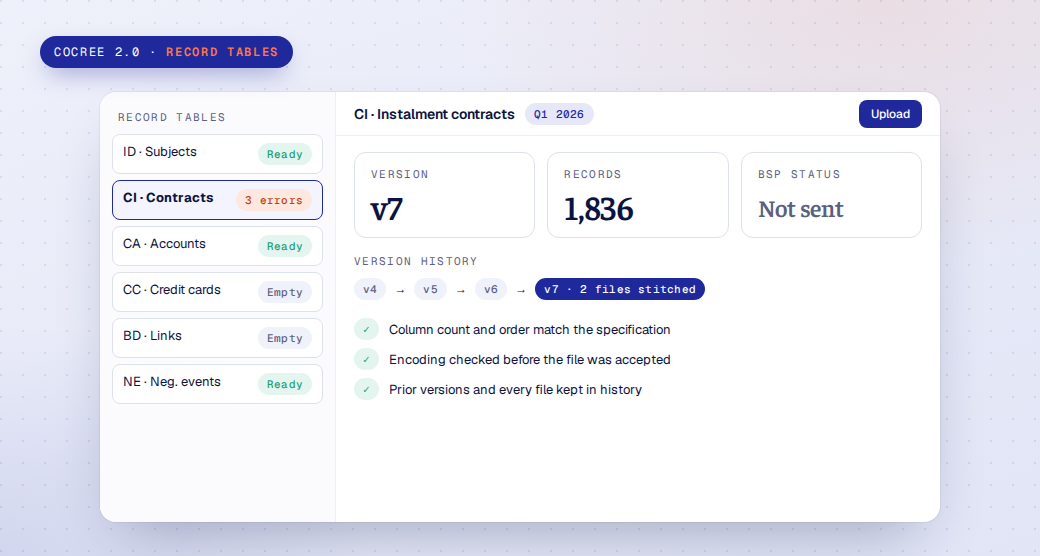
Every record type is a table with its own owner, in specification order. Files append or start a new version, and column count, order and encoding are checked on the way in.

COCREE 2.0, the BSP’s Enhanced Comprehensive Credit and Equity Exposures Report, asks for borrower- and counterparty-level records on every credit and equity exposure. The BSP checks every file but provides no validation tool, so the bank has to catch errors first. Wekalp’s COCREE package does that, from versioned record tables and BSP code mapping to the filed, encrypted file, for universal, commercial, rural and cooperative banks.
A COCREE 2.0 filing is a set of record files, not a template of totals. Each record type has its own fields, codes and rules, and the counts in the header and footer have to agree with the records themselves.
A header and footer declare the provider, the period and the expected counts of subjects, contracts and negative events.
Every borrower, co-borrower, guarantor or surety, and the links between them, such as directors, owners and parents.
Six contract types, from instalment loans and credit cards to investments and off-balance-sheet items, each with role, phase and status.
Litigation, bankruptcy and similar events, recorded against each subject.
| What the BSP expects | How Wekalp’s COCREE package handles it |
|---|---|
| Record-level data on every borrower, counterparty and exposure | A versioned table for each record type, with its own owner, loaded from your core banking and loan systems |
| Values from the BSP’s code lists, not your internal codes | Core-system codes mapped once to the BSP’s lists and reused every period |
| Clean files, with no BSP validation tool to check them first | Field, cross-record and file-level checks run before the file is generated, with the regulator’s own error codes |
| Errors corrected and resubmitted | Corrections opened from the BSP’s response file and tracked against the original filing |
| Totals certified by authorised signatories | Maker-checker approval for each table, with control totals computed from the approved records |
| Secure, correctly named submission files | Files generated, encrypted and named to the BSP’s specification |
Submission requirements vary by type of institution. File format, schema and reporting timelines differ for universal and commercial banks, thrift banks, digital banks, rural and cooperative banks and other covered institutions. Wekalp’s COCREE package supports the formats each one files, in XML or TXT, and is offered to rural and cooperative banks as well as universal and commercial banks.
COCREE 2.0 expects values from the Data Dictionary’s List of Domains, such as product, location, country and currency codes, not the codes your systems use. The package maps them, keeps every record table versioned, and runs the structural and business checks before the file is generated, so the BSP’s exception report has nothing to send back.
Every record type is a table with its own owner, in specification order. Files append or start a new version, and column count, order and encoding are checked on the way in.
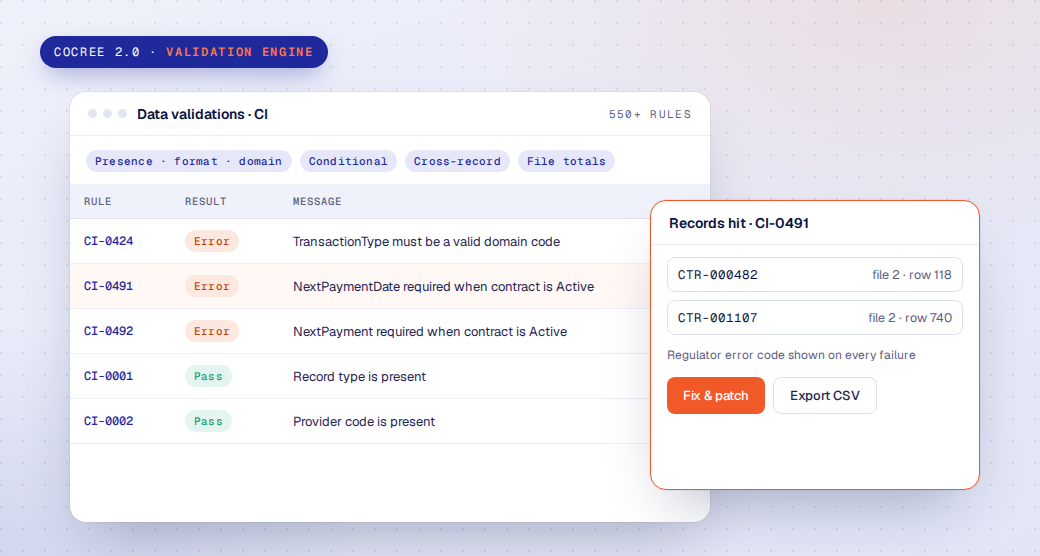
Rules for presence, format and domain; conditional and cross-field; across records and prior filings; and file totals. Failures carry the regulator’s own error codes and open the records behind them.
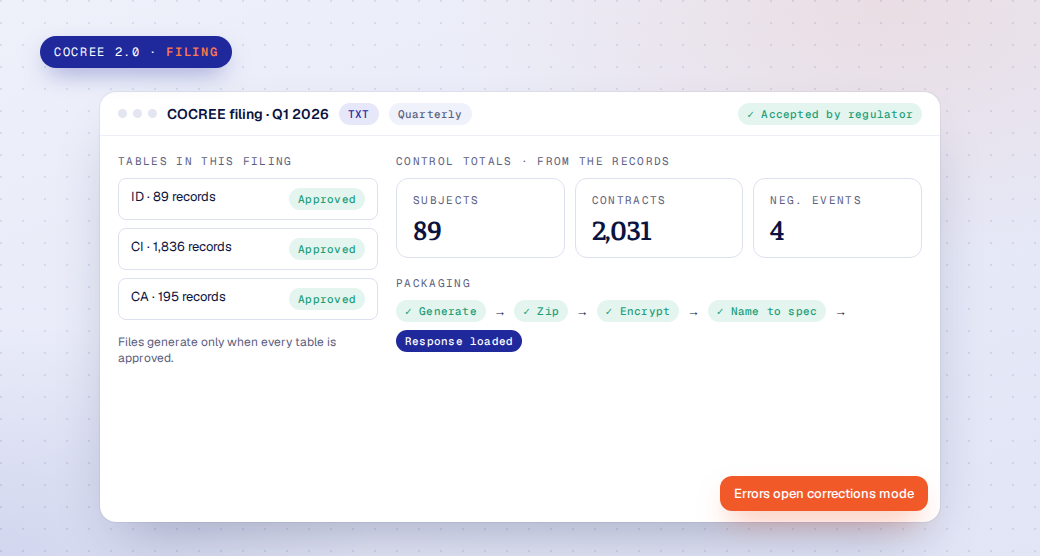
Files generate only when every table is approved, with control totals computed from the records. Response files load back to accept the filing or open corrections.
The BSP’s Data Dictionary defines every COCREE 2.0 field: its format and length, whether it is mandatory, the code list it must match, and how it depends on other fields and on the header. Wekalp runs those rules as the regulator writes them, before the file is generated.
The Control Prooflist asks authorised signatories to certify the records and amounts you send. The platform gives them the evidence: approvals per record table, control totals computed from the approved records, and a history of every filing and correction.
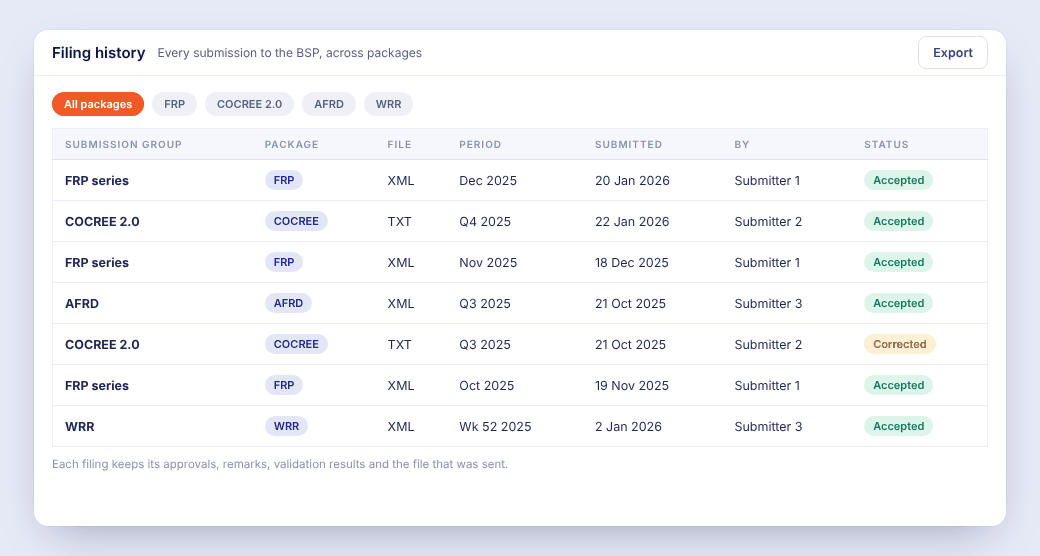
Every submission to the BSP, for FRP, COCREE 2.0 and the other packages, with its approvals, remarks, validation results and the file that was sent.
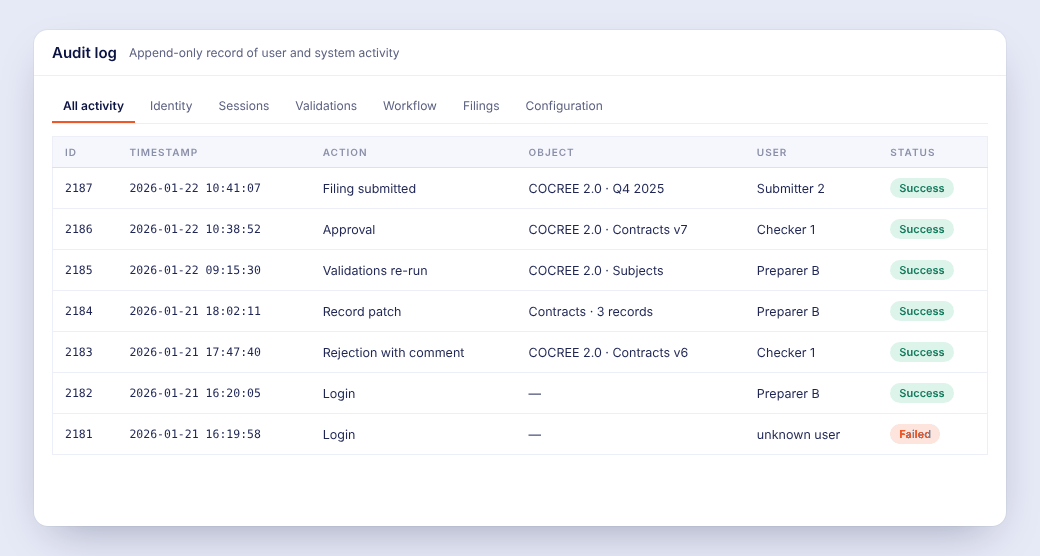
Logins, validations, patches, approvals, rejections and filings, each time-stamped against the user and the object, for examiners and internal audit.
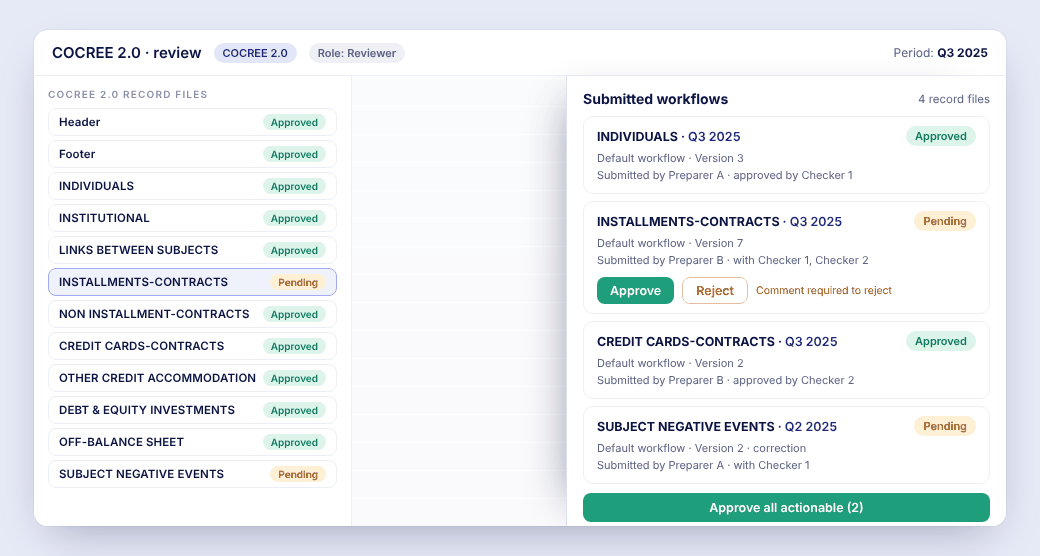
Each table is approved before the file can be generated. A rejection needs a comment, so the preparer knows what to fix.
COCREE 2.0 is the BSP’s Enhanced Comprehensive Credit and Equity Exposures Report, introduced under Circular No. 1184. It enhances the original COCREE under Circular No. 1131 and asks for borrower- and counterparty-level records on every credit and equity exposure, so the BSP can monitor credit risk across the financial system.
Yes. Submission requirements, including file format and schema, vary by type of institution, and some institutions can file in XML or TXT. Wekalp’s COCREE package generates the format your institution files.
No. The BSP returns a validation (exception) report through the BRMS COCREE 2.0 module after submission, but does not provide a validation program. Banks are expected to adopt their own tools. Wekalp’s validation engine runs the checks before you file.
Corrected records are resubmitted to the BSP and replace the earlier ones. Wekalp opens corrections from the BSP’s response file, so the team fixes the affected records and tracks each correction against the original filing.
Yes. The package is offered to rural and cooperative banks as well as universal and commercial banks, in XML or TXT. It can run on-premises, in your own cloud account so data never leaves the bank, or in Wekalp’s hosted cloud.